Roof rules are not the same in every city. Each city runs its own building department and may add local rules on top of the state code. Fire hazard zones and building climate zones also change from place to place.
This page has two parts. First, the rules and data that apply across the whole City of Los Angeles. Second, our local guides.
Local guides
Four guides cover parts of the City of Los Angeles. Each one uses the city's open permit data, census housing data, the 2025 fire hazard maps and the state climate zone list for that area.
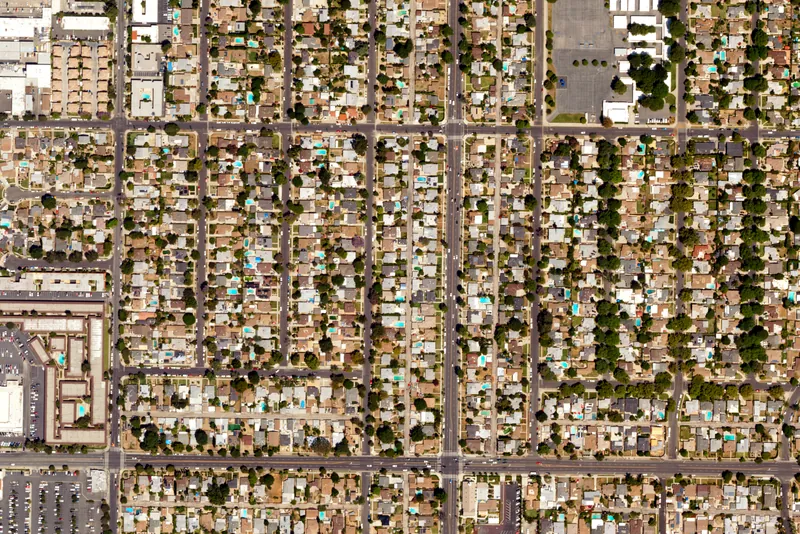
- San Fernando Valley: almost half the city's reroof permits, hillside fire zones and climate zones 9 and 16.
- Northeast LA: Highland Park, Mt. Washington, Silver Lake and Echo Park. Pre-1940 houses, mostly Very High fire zones, HPOZ review.
- Westside: Mar Vista, Westchester, Brentwood, Venice and nearby areas. Coastal climate zone 6 and Palisades-area fire zones.
- South LA: South LA, Baldwin Hills, Leimert Park and West Adams. The oldest housing in this guide and climate zone 8.
One guide covers a separate city:
- Long Beach: its own permit rules, a small-job roofing exemption, historic district roof rules and no mapped fire zones.
For county-wide topics, see roof permits and wildfire roofing. Altadena and other burn areas are covered in the wildfire guide.
Rules across the City of Los Angeles
Everything below applies to homes inside City of LA limits. The Los Angeles Department of Building and Safety (LADBS) handles permits. Check that your address is inside city limits first. Some ZIP codes mix city and county land.
Reroof permits since 2021
We counted permits in the city's open permit data whose work description says "reroof," "re-roof" or "re roof."
| Year | City of LA reroof permits |
|---|---|
| 2021 | 9,024 |
| 2022 | 10,383 |
| 2023 | 14,511 |
| 2024 | 14,274 |
| 2025 | 11,954 |
| 2026 (to Oct. 31) | 12,088 |
| Total | 72,234 |
About 82% were for 1 or 2 family homes. Permits are not finished jobs, and unpermitted work does not appear.
The citywide wood shake ban
LADBS bulletin P/BC 2026-013 took effect on January 1, 2026. It says all wood shake and wood shingle roof covering is prohibited in the city. That covers new roofs, reroofs and repairs.
There is one narrow exception. Minor repairs, up to 5% of the roof area, may be allowed with Class B wood shingles or shakes. The owner has to file a "Request for Modification of Building Ordinance" and pay an appeal fee.
The bulletin also sets a 50% line:
- More than 50% of the roof replaced within one year. The whole roof must meet current code. All old wood shakes come off.
- 50% or less within one year. Only the replaced area must meet current code.
In both cases the new covering must be a code approved Class A, B or C roof. It must be Class A in a Very High Fire Hazard Severity Zone. In Fire District No. 1 it must be Class A or B. See our guide to Class A roofs and vents.
LA's own cool roof rule
The city's Green Building Code adds a cool roof rule for homes. A joint LADWP and LADBS flyer (revised July 2022) lists the minimums:
| Roof slope | 3-year aged solar reflectance | Thermal emittance | Or SRI |
|---|---|---|---|
| Low slope (2:12 or less) | 0.65 | 0.85 | 78 |
| Steep slope (over 2:12) | 0.25 | 0.85 | 20 |
The flyer lists exceptions. A cool roof is not required for roof repair. It is not required when 50% or less of the roof area is replaced. Roofs where solar is being installed, and roofs with at least 25 pounds per square foot of thermal mass, are also exempt. Read more in cool roofs in California.
Permits and paperwork
LADBS issues "Express Permits" for simple projects that do not need plan check. Online, these are applied for through PermitLA. The department's page links to a permit fee calculator. It does not publish a flat reroof fee, so we do not list one.
At the end of a reroof, LADBS uses a Re-Roofing Certificate of Compliance (IN.Form.12). It certifies that the work and materials meet the city's roofing rules. The licensed contractor signs it. If the owner did the work as an owner-builder, the owner signs. The form goes back to the inspector or is mailed to the department.
For the general steps, see reroof permit basics.
Fire hazard zones in the 2025 maps
CAL FIRE issued new recommended Fire Hazard Severity Zone maps for the city on March 24, 2025. LAFD said state law requires the city to adopt them by ordinance. It also said more parcels will be affected than before.
We overlaid the 2025 recommended map data on the county's city boundary layer. Inside city limits we measured about 158.7 square miles in the Very High zone. That is about one third of the city's land. We also measured about 14.7 square miles High and 10.6 square miles Moderate. This is our own calculation from public map data. Use CAL FIRE's map viewer to check a single address. More in our fire hazard zone guide.
How old the housing is
Census ACS 2024 1-year estimates put the median year built at 1965 for the city's housing units. About 19% of units were built in 1939 or earlier. About 69% were built before 1980. These are survey estimates with margins of error.
Climate zones vary across the city
The Energy Commission's ZIP list puts city ZIP codes in Building Climate Zones 6, 8 and 9. Coastal ZIPs like 90291 (Venice) and 90731 (San Pedro) are Zone 6. Downtown 90012 and most of the Valley are Zone 9. Sunland's 91040 is listed as Zone 16. The state's 2025 reroof cool roof chart applies to steep roofs in Zones 4 and 8 through 15. The city's own rule above applies on top of that. A ZIP can span more than one zone, so confirm yours with the CEC lookup tool.


